


Overview
Time: 4 hours
Trainers: 2-3
Audience: 0/5 to 2/5 experience levels. No soldering required!
* Beginner: never touched Meshtastic
* Intermediate: installed Meshtastic, played with the app, messaged people
Fee:
You must purchase the $80 Meshtastic Workshop Equipment add-on with your SCaLE registration to attend. Seats are limited. The $80 fee pays for the starter device attendees will configure and keep. This kit will look similar to this when assembled, and consists of:
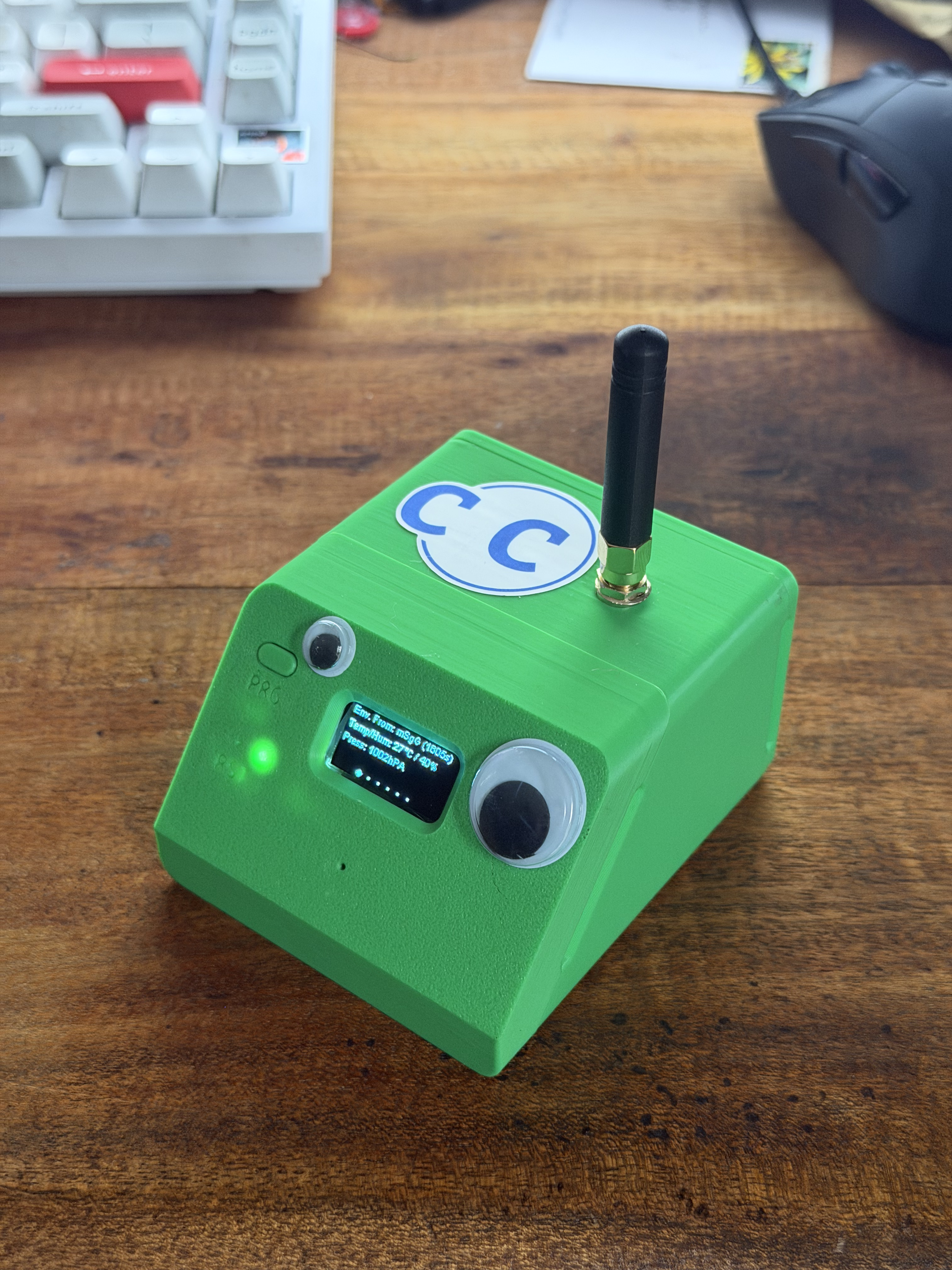
* Heltech v3.2
* 3aH battery
* GPS sensor for reporting position
* Environment sensor for measuring humidity, temperature, and barometric pressure
* An ultrasonic distance sensor
* Extra sensors based on availability
* A few specially-designed stickers to add flare
* A 3d-printed case specifically designed to include device headers: you don't need to solder anything on!
Requirements for participation:
* A laptop with a USB-C or USB-A port running OSX/Windows 11
* An Android or iOS smartphone with Bluetooth
Goals:
* Get beginners started
* Explore basic and advanced functionality
* Enable attendees to keep advancing on their own afterwards
Pre-programmed nodes for the attendees to interact with and show-and-tell:
* Mesh BBS
* Weather-reporting node
* GPS-reporting node
* Self-powered solar node (stretch goal)
* A node with a GPIO LED that can be remote-controlled (stretch goal)
* A node with MUI (stretch goal)
Outline
1. 0-10m: Introduction & overview
* Who we are:
* Background, experience, and what got us into LoRa/Meshtastic
* Why we are here:
* Get to 3/5 Meshtastic experience level
* Know how to keep growing afterwards
* Discuss terminology and configurations:
* LoRa vs. Meshtastic vs. MeshCore
* Channels
* Sensors
* Cryptography
* Location obfuscation
* Discuss LoRa limitations and capacity
* Channel capacity
* LongFast overuse:
* How many nodes actually cause problems?
2. 10-20m: Pass out devices
3. 20-45m: Installation & basic functionality
* Demo basic functions:
* Sending and receiving messages
* Seeing other nodes on a map
* Interact with the prebuilt BBS
3. 45-75m: Telemetry
* Install and configure sensors
* GPS
* Environment (temperature, humidity, pressure)
* Distance
4. 75-90m: Introduction to advanced features
Introduce what we’ll be diving into in part 2, after the short break:
* Overview of administering remote nodes
* Overview of controlling remote nodes’ GPIO
90-110m: Intermission
Ten-minute break, then pause for ten minutes of questions and clarifications.
1. 110m-140m: Advanced features
* Split into pairs
* Configure remote node administration
* Take turns changing configuration
* Control GPIO devices on remote nodes
* Read state of GPIO pins from your partner
2. 140m-170m: Explore MQTT for remote community enablement
* Configure devices to communicate with a prepared MQTT server
* View data uplink and downlink
* Discuss considerations of MQTT use for Meshtastic
3. 170m-180m: Introduce Mesh Marauder research
* What are the repercussions of this tooling
* How does it work, where the gaps in Meshtastic are that allow it
180m-200m: Intermission #2
Ten-minute break, then pause for ten minutes of questions and clarifications.
1. 200m-230m: Hands-on Mesh Marauder replication
* Go over configuration backups
* Split into groups of 3+
* Each group to set their own channel to work with
* Run commands to over lora to
* View unencrypted metadata
* Take turns injecting packets and impersonating devices
2. 230-240m: How to keep progressing
* Show and note resources for research and questions:
* Documentation on Meshtastic website
* Github repositories
* Discord
* Dive into the device/firmware debugging process
* Show how and where to submit bugs, feature requests
* Discuss perceived antipatterns, cognitive misalignments in terminologies, features
* Antenna theory
* Show-and-tell about devices we brought:
* Meshtastic BBS
* PoE node and MQTT server
* Solar-powered node (stretch goal)
* Meshcore nodes (stretch goal)
* Provide a final link & QR code with a listing of all links provided today.