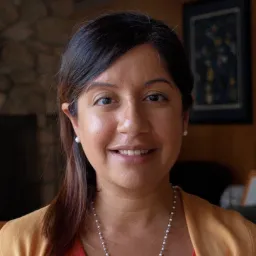
Avni Khatri is Sr. Director of Education in GitHub's Developer Relations organization, helping learners access the tools and resources they need to successfully build software products. Avni is passionate about working with learners and educators of all kind to make coding available to the next generation of developers around the globe. She also volunteers with Internet-in-a-Box.
Presentations
Where in the World is Internet-in-a-Box?
Internet-in-a-Box (IIAB) “learning hotspots” serve dozens of countries, e.g., in remote mountain villages in India, over a local Wi-Fi hotspot, bringing Wikipedia, Khan Academy, healthcare libraries, and OpenStreetMap (OSM), all without the need for internet or a mobile data plan. Come and see the NEW IIAB Maps. Anyone can self-host and customize to the region they need—including vector tiles, mountain relief topography tiles, and satellite photo tiles—all with powerful full-text search. Our new IIAB Maps are flexible and customizable, robust, offline-first, and localizable to help almost anyone, anywhere!
Can Teachers Help Teachers with AI?
As much as we need to and should support students with adopting new technologies such as AI, educators are being thrown into the deep end and expected to swim with very little instruction or support. From working with educators while at GitHub and as part of Internet-in-a-Box (IIAB), it is clear that we ask much of our teachers. They are expected to learn not only basic computing and software development, but also version control, collaborative software development, and now, how to teach about and with AI. This is daunting anywhere and even more daunting in the developing world where experienced mentors and resources can be scarce.
Wikipedia, GitHub, and arXiv show us that free and open access can be transformative and lower barriers of access to entry to new skills and careers. We will share educational experiences with GitHub, Internet-in-a-Box, and AI and our work to provide online and offline tooling and content to remote regions worldwide. A model of federated ecosystems can empower educators, learners, and community organizers everywhere, turning passive learners into active creators in the AI era.
Open Source for Good
Join us for a hands-on "Open Source for Good" workshop where participants of all skill levels will contribute to real-world social impact projects. Working alongside nonprofit leaders, you'll learn contribution workflows while making meaningful improvements to vetted projects. From beginner-friendly documentation updates to advanced feature implementation, you'll gain practical experience with GitHub tooling and collaborative development practices.
Kids on Computers
Come learn what it's like to travel to different countries setting up labs for underprivileged kids. With our 7 years of experience setting up labs in Mexico, India, Morocco, Nepal and Argentina, Kids on Computers has learned the impact that a small group of active volunteers can make in the lives of many. Using free and open source software, donated equipment and grants, we set up computer labs in schools around the world. Come learn and talk to us about your dreams for helping others.
Open Source Is Awesome
As a counterpoint to Bryan Lunduke's Linux Sucks presentation, join us as we show some Linux, Free and Open-Source software projects that have changed lives. From helping the homeless to educating our youth see how our community is using free and open-source software to make our world a better place.
Cultivating Sustainable Communities: Kids on Computers in Oaxaca, Mexico
Kids on Computers is a 501(c)(3) non-profit organization setting up computer labs for underprivileged kids around the world. Our mission is to provide increased access to educational content so kids can better their own lives and eventually the lives of their communities. We currently have 20 labs in 5 countries including 12 in the region of Oaxaca, Mexico.
Kids on Computers: Enabling Education through Technology
Kids on Computers is a nonprofit providing free computers and FOSS to kids worldwide in order to increase educational opportunities. We have set up 16 computer labs in 5 countries. You'll hear from KOC volunteers about their experiences visiting countries and communities they've never been to, what it's like to set up a lab, and how they feel they made a difference. Come learn how you can join and make the world a better place by teaching kids and teachers about technology and FOSS!